A new trade corridor can connect markets. But for an Italian machinery manufacturer entering India, the immediate questions are closer to the ground: Where should we locate? What will our products cost after import duties? How will we compete and serve customers locally?
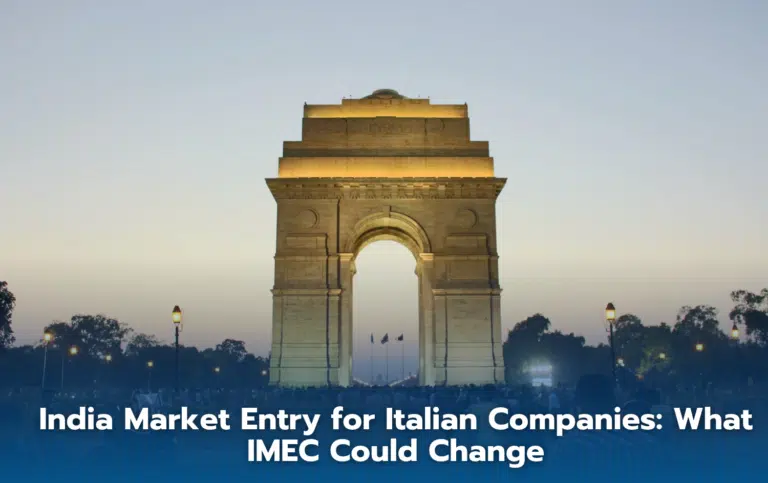
These questions sit at the heart of India market entry for Italian companies and explain why the India–Middle East–Europe Economic Corridor (IMEC) deserves attention beyond transport and infrastructure headlines.
Italy and India have set an ambition to exceed €20 billion in bilateral trade by 2029, with machinery, automotive components, clean technologies, pharmaceuticals and other industrial sectors among their priorities. For business leaders, the task is to identify where that cooperation connects with a commercially viable expansion plan.
What could IMEC mean for Italian businesses?
IMEC is a proposed connectivity initiative linking India, the Middle East and Europe. Its ambition extends across trade infrastructure, energy and digital connections. Italy’s hosting of the IMEC Forum in Trieste in March 2026 reflects its interest in developing this wider economic network.
For Italian businesses, its potential lies in three areas:
- More connectivity options: Additional links could support greater flexibility in how companies move goods and organise supply chains.
- Closer industrial cooperation: Stronger connections could support partnerships between Italian technology providers and Indian manufacturers.
- Energy and digital collaboration: The corridor’s wider scope creates potential beyond physical goods, including infrastructure and technology projects.
These are prospective benefits, rather than guaranteed operating advantages. In May 2026, Italy’s Foreign Minister acknowledged that instability in West Asia required a reassessment of IMEC’s short- and medium-term implementation schedule. Companies should therefore build their business cases around existing infrastructure and treat future corridor benefits as an additional scenario.
India’s role extends beyond an export destination
Italy’s industrial relationship with India increasingly includes production, research and development, and participation in global supply chains. Machinery, advanced manufacturing, automotive components and clean technologies feature prominently in bilateral cooperation.
For an Italian company, this opens several possible paths: selling through a local partner, establishing a subsidiary, building service capabilities, sourcing locally or evaluating manufacturing.
The right choice depends on the business. A machinery supplier may need reliable spare-parts availability and technical support. A component manufacturer may prioritise proximity to customers and qualified suppliers. Each model requires a different investment, team and operating structure.
That is where the broad India–Italy growth story becomes a company-specific decision.
SCM: turning an India expansion plan into practical decisions
SCM, the Italian machinery group, faced precisely this challenge when evaluating business operations in India.
The company needed to assess its entry options, understand competitors, identify suitable locations for a corporate office and warehouse, and determine how product classifications and import duties would affect pricing.
M+V ALTIOS supported SCM through:
- Business-model and competitor analysis to inform its market approach.
- Import-duty and HSN-code analysis to clarify product cost structures.
- Comparison of bonded warehouses, Free Trade Warehousing Zones and Domestic Tariff Area warehouses.
- Location and feasibility assessments for its office and warehouse.
According to the published case study, this work helped SCM strengthen product positioning and optimise costs and time through logistics, supply-chain and duty advice.
Read the full SCM case study: Setting up business operations in India.
SCM’s experience illustrates the operational preparation behind market entry. It is not presented as an IMEC-linked project.
Planning India market entry for Italian companies
The practical lesson is straightforward: assess the operating model alongside the market opportunity.
Before committing to an India expansion, leadership teams should answer five questions:
1. Who will buy-and why?
Identify target customers, purchasing criteria and competing offers. Test whether the company’s differentiation translates into demand at the intended price.
2. Which local presence does the business need?
Compare distribution, a subsidiary, local sourcing and manufacturing against customer expectations, investment requirements and the desired level of control.
3. What is the full cost of serving the market?
Build a realistic picture of freight, duties, warehousing, inventory, distribution and after-sales support. Test how changes in these costs affect margins.
4. Where should operations be located?
Evaluate customer access, supplier availability, talent, logistics and operating costs together. The lowest-cost location may not deliver the strongest overall business case.
5. Who will execute the plan locally?
Define responsibility for recruitment, finance, tax, compliance and commercial delivery. Set milestones that connect incorporation and setup with operational readiness.
These decisions help companies prepare for growth today while retaining flexibility as regional connectivity develops.
From Italy to India, with coordinated local support
Maier + Vidorno, part of the ALTIOS Group, combines teams in India with dedicated support from Italy to help businesses assess, establish and develop their Indian operations.
Support spans market assessment, partner identification, business setup, recruitment and the financial, tax and operational requirements of running a local business.
IMEC adds a long-term dimension to the India–Italy relationship. The immediate opportunity for companies is to establish where they can compete, what local capabilities they need and how to execute with clear responsibilities.
Considering expansion into India? Speak with the ALTIOS Italy and India teams to assess your market-entry options and build a practical implementation plan.