
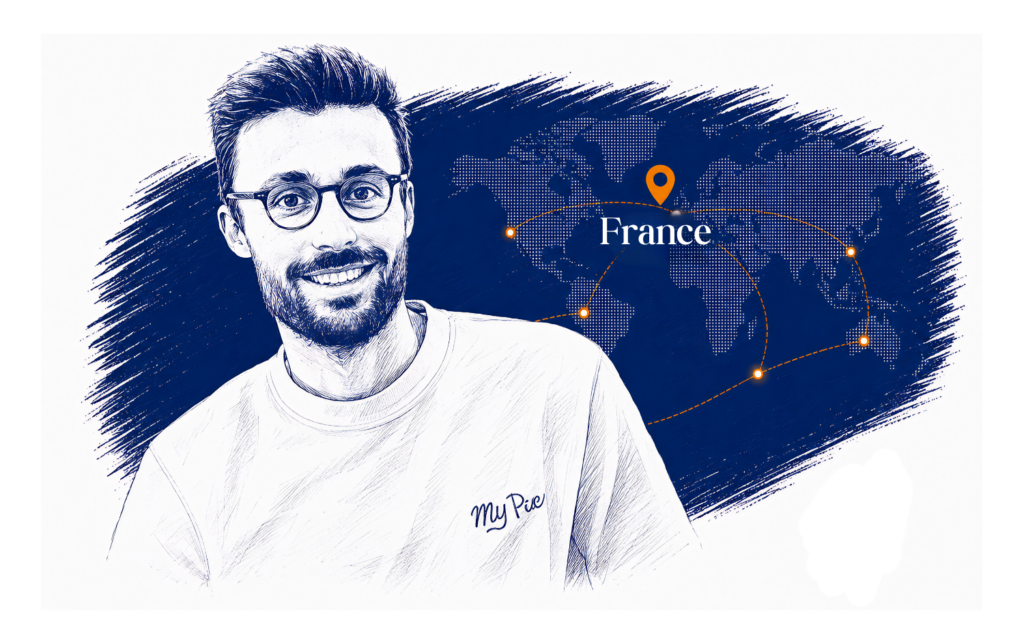
Could you introduce My Pie and its international journey?
I founded My Pie in 2015 with a friend right here in Mayenne. Initially, we wanted to import a concept we had discovered in New Zealand. Gradually, the project evolved into a comprehensive hot snacking offering tailored for supermarkets. It is a turnkey solution: we provide the products, the heated display units, and the packaging. A supermarket – typically a convenience format like Carrefour City or Franprix in France – can contact us and launch a hot food section in a matter of weeks.
Today, we offer around fifty products across ten product lines: pizzas, croque-monsieurs, quiches, chicken tenders, ready meals, and more. Everything is manufactured in-house at our Mayenne facility using natural ingredients, with zero additives or preservatives – that is a core pillar of our value proposition. We currently have 200 employees. We started exporting two years ago, first to Belgium, then the Netherlands, Germany, and Spain, and we are currently running feasibility studies for the UK.
What were the key milestones in your international development?
The first step was securing the right partners within franchised store networks, which was especially crucial since we had zero brand awareness outside of France. For example, we entered Belgium through a partnership with Carrefour Belgium. We deliberately chose not to outsource our sales force because our products are baked and prepared directly in-store, which demands continuous, close-proximity field support. We have roughly thirty sales reps per country, with a heavy focus on on-the-ground support.
Logistically, we quickly realized that inventory had to be physically held in each country for deliveries to be viable. We then set up local subsidiaries with Altios’s backing, before moving on to hire local staff on permanent contracts. Our commercial strategy follows a consistent blueprint: we start by working with individual stores to build our operational credibility, and once the model is locally proven, we target national partnerships.
What was the most foundational decision in your global expansion?
It came directly from listening to our partner stores. We noticed that some of them were starting to bake our products first thing in the morning because customers were asking for them at that hour. That observation led us to develop a breakfast range for markets where consumers eat savory food in the morning – which is perfectly natural in Belgium or the Netherlands, for instance.
A second decisive move was storing our products locally in each country rather than shipping from Mayenne. This shift slashed delivery times, reduced supply chain risks, and gave us a genuine operational anchor in every market.
What international success makes you the proudest?
Belgium is clearly our most mature market at this stage. We have over 300 partner stores there, strong per-store consumption, and a highly satisfying relationship on both sides. But what we are particularly proud of is having successfully attracted non-French retailers – Flemish groups, and now Dutch ones. These are demanding partners who expect a high level of rigor in delivery quality and support. Meeting their standards is a true stress test for the solidity of our model.
How do you manage geopolitical risks in your global operations?
At our stage of development, geopolitical risks have a relatively limited direct impact, since we only operate in neighboring European countries. The most tangible effect is the rising cost of fuel for our sales teams. Beyond that, the current global climate hasn’t materially disrupted our operations.
COVID was a completely different story. When the lockdowns hit, consumption collapsed almost overnight; people stopped going out, cooked at home, and our supermarket sales plummeted brutally. For two to three months, we sold practically nothing. We had to take out a state-backed loan to cover payroll and put a significant portion of our workforce on furlough. We then rebounded [VC2] gradually, largely because our products are individually wrapped, which made them compliant with the new health constraints. Adjacent sectors, like salad bars, were hit harder and for much longer than we were.
Is there a specific country or market that has been most pivotal to your development?
Given that our international expansion is only two years old, Belgium is clearly the most significant market to date – it’s the only one we’ve operated in long enough to extract real lessons. The other countries only went live in late 2025, so it is still too early to gauge their full potential. Spain and Germany are slated to become increasingly important in the coming years.
What drives this expansion is our in-house product innovation capability. We have a six-person R&D team with their own lab right inside the factory. When we enter a new market, we rapidly try to meet with store managers, organize tastings, and gather consumer feedback. We adapt our product lines accordingly – sausage rolls in Belgium are a prime example. Our innovation cycle takes between six and twelve months, aiming for about six months from concept to launch: internal tasting with a minimum score of eight out of ten, a pre-industrialization phase, pilot testing in a few stores, and finally a broader roll-out if the results are conclusive.
What has been your biggest international challenge?
The UK is our biggest hurdle right now. It is a highly centralized retail market with very few franchised stores, which makes our usual playbook – starting with pilot stores and building up – completely ineffective. To break in, you absolutely need a direct, top-down agreement with the headquarters of a major retailer like Tesco or Sainsbury’s. That is incredibly difficult when you have no brand awareness and are coming in from abroad. Everything hinges on having the right contact at the right level, and ensuring that contact is genuinely interested in your value proposition. It’s an all-or-nothing game: either you have the right network and can roll out quickly, or you simply cannot gain a foothold in the market.
Which model should be prioritized for global growth?
We currently prioritize organic growth, which perfectly suits the pace and nature of our expansion. Using agents or importers introduces a layer of distance that can erode your control over how the product is pitched and supported in-store – which is critical in our business. External growth via M&A is an avenue we are exploring, but with caution: integrating a team from another company into your own corporate culture is genuinely difficult and frequently fails. In many cases, it is more efficient to build your own infrastructure (a new warehouse, a new production unit) than to absorb someone else’s. That being said, we aren’t ruling anything out for the future.
What truly made the difference in that success?
Clearing their requirements says something important about where we stand. It is relatively easy to succeed on your home turf, where everything is familiar. But earning the trust of culturally distinct partners – retailers with high standards who are used to dealing with established brands – and delivering exactly what they expect, that is the proof that you’ve built something rock solid. It demonstrates that our concept and execution are genuinely exportable and scalable, not just tailored for the French market.
What major shifts must SMEs anticipate to adapt to the new global landscape?
The most urgent and profound transformation, to my mind, is artificial intelligence. It is already reshaping entire business functions, and companies that don’t adapt quickly risk being outpaced by leaner, highly automated competitors. This has a direct implication on how you design your organization: investing heavily in headcount for roles that AI is highly likely to automate in the near term carries real risk. More broadly, I believe the current climate rewards companies that maintain lean and flexible structures. The businesses that navigate this era best will be those capable of adjusting rapidly, automating intelligently, and avoiding the trap of a bloated organization that kills their agility.
What role should a partner like Altios play in the future?
Altios played a decisive role in helping us set up the legal and administrative infrastructure in each country: incorporating subsidiaries, establishing HR frameworks, and ensuring local compliance. The time saved is massive: without a trusted partner who already knows the legal landscape, we would have had to source and manage multiple local vendors in each country, which would have been both slow and risky. For a company our size, this type of operational support is invaluable. We are not a massive corporation with a global legal department; we are a growing SME, and Altios gives us access to expertise and bandwidth that would otherwise be out of our reach.
What three pieces of advice would you give an SME executive looking to accelerate globally?
First, take the time to refine your strategy and maintain a clear course. In a complex environment, the most resilient companies are often those that know exactly where they are headed, while remaining agile enough to adjust their trajectory.
Second, secure your value chain and identify any vulnerabilities in your operating or supply model. This structural solidity is essential for achieving sustainable international success.
Finally, rely on a trusted team that is fully aligned with the company’s values and operations, and capable of deploying rapidly into key markets.
Learn more about My PIE