Could you introduce Shift4Good and its international role?
We are a venture capital fund focused on the decarbonization of transportation and logistics. We invest two-thirds of our capital in Europe and one-third in Asia, primarily in startups driving clean mobility, electric vehicles, and the circular economy.
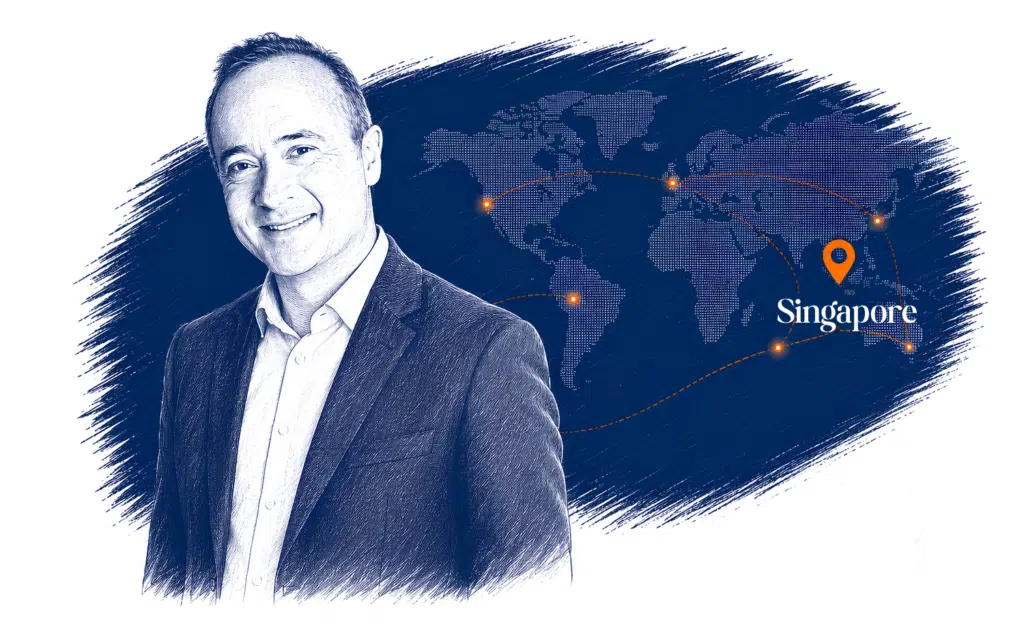
Our team consists of 18 people, including the four founders, split between Paris and Singapore – where I have been based for 21 years. We have been a global firm since day one; we never envisioned operating any other way.
We currently manage a portfolio of 18 companies worldwide with €220 million in assets under management (AUM), writing checks of up to €20 million per company.
What were the key milestones in your international development?
The first step was forging a truly global corporate culture. All our partners had prior international experience, which was a non-negotiable prerequisite for us.
Next, we recruited people with that same international DNA: the 14 other team members we work with all represent different nationalities and global backgrounds. All our internal interactions are in English – an absolutely essential element of our DNA.
Finally, we generated quick wins and concrete case studies early on. For example, we invested in Bound4Blue and guided their expansion in Asia through our networks and Altios – entrepreneurs can literally call Bound4Blue’s CEO to verify what we actually delivered.
What was the most foundational decision in your global development?
The first was our core positioning, what I call our “cross-border” thesis: we invest in a European company to scale it in Asia, and in an Asian company to scale it in Europe.
Naturally, the startups that come to us aren’t just looking for capital; they want direct or indirect value-add for their global expansion.
The second was our organizational structure: team members based in Singapore actively work on European deals, and vice versa. From the very beginning, we wanted to ensure our teams didn’t think in regional silos.
What international success makes you the proudest?
We successfully attracted global LPs (Limited Partners) from Luxembourg, Singapore, Indonesia, Australia, and the Middle East – a tough feat for a team of four French founders managing a French-domiciled fund. That is a massive achievement.
We are also extremely proud of our work with Bound4Blue, a Barcelona-based company that installs rigid sails on cargo ships to cut energy consumption using wind power. Since 95% of new vessels are manufactured in Asia – specifically China, Japan, and Korea – having a footprint there is absolutely critical for them. We helped them establish operations in Singapore and China, notably alongside Altios, and successfully brought in Asian co-investors for their latest funding round. Those three Singapore-based strategic investors are now accelerating their Asian rollout.
Finally, operating dual headquarters in Singapore and Paris simultaneously is highly unique. It gives us a symmetrical anchor in both Asia and Europe. The networks we’ve built over 21 years in Asia allow us to move much faster when supporting our portfolio companies.
Is there a specific country or region that has been most pivotal to your global development?
Singapore. And the crucial distinction here is that it’s not just a branch office; it is a true headquarters on equal footing with Paris. That dual positioning has been at the very core of our approach since day one.
What has been your biggest international challenge, and what lesson did you learn from it?
Speaking from my own personal experience – rather than for our current firm – a major challenge arose from trying to open too many countries at once. If you try to launch in 5 or 10 countries simultaneously, you end up cutting corners, and half-measures never work in global business. You don’t commit enough capital per country; you spread yourself too thin, and the ROI ends up being mediocre, or even zero in some markets.
The main takeaway is the exact opposite of spreading yourself thin: carefully select each country, treat it as a unique project, find the right partners, hire the right teams, and deploy the necessary capital. The right number of countries to open depends entirely on the size of the company and the available capital. If you only have a million dollars, you should probably only open one or two countries, but do it right.
How do you practically manage geopolitical risks in your global operations?
We simply do not invest in regions that are too risky or geopolitically unstable. We also avoid investing in currencies other than the US dollar or the Euro.
Furthermore, we actively ask our 18 portfolio companies how they factor in macro crises and downside scenarios, and then we help them build out concrete action plans.
What major shifts must SMEs embrace to succeed globally?
SMEs need to drop the “export” mindset: you have to establish a physical footprint, not just ship goods. Some companies try to push the exact same product in a foreign country, but every market has its own rules, consumer habits, and expectations. You don’t try to sell an Alpine winter dish in India. Copy-pasting a domestic model abroad just doesn’t work, except in extremely rare cases.
You also need real-time visibility over your supply chain; it is a massive competitive advantage. We are no longer in the 1990s sending faxes: you need to know exactly what is happening in real time, even on the other side of the planet. Investing in IT tools is critical here.
For instance, we invested in Shippeo, a French company that gives clients real-time supply chain visibility – where their container is, if there’s a bottleneck, whether it will arrive on time – using AI to anticipate stockouts. Supply chain resilience is going to become more important than pure cost.
Finally, success requires hiring top-tier local talent, and that takes capital.
What skills will become indispensable for global success?
Adaptability and agility: Being willing to challenge your own assumptions and certainties.
Navigational skills: The ability to maneuver through complex environments alongside high-caliber local teams.
Cross-cultural respect: Genuinely respecting the cultures of your employees, partners, and clients.
Moving forward, what do you believe is the best model for international expansion?
The goal isn’t to pick a single model, but to sequence them effectively at the right time.
Solid partnerships: Testing the waters through the right local agent. Altios is highly valuable here, because choosing the wrong initial partner can sabotage everything that follows.
Organic growth: Stepping up to a true direct investment with a dedicated local team, adapting the product based on real market feedback.
What role should a partner like Altios play?
Altios has a global footprint with an end-to-end offering: operational deployment, partner sourcing, local entity incorporation, business development, securing local financing, right up to M&A advisory.
What three pieces of advice would you give an SME or mid-cap executive looking to accelerate globally?
Ditch the “Export” mindset: Localize your business model rather than simply shipping a domestic product across borders.
Invest heavily: Recruiting top-tier local talent requires serious financial firepower. You need shareholders who understand this.
Choose the right partners: Lean on experts like Altios to save time and avoid highly costly mistakes when selecting local stakeholders.
Learn more about Shift4Good